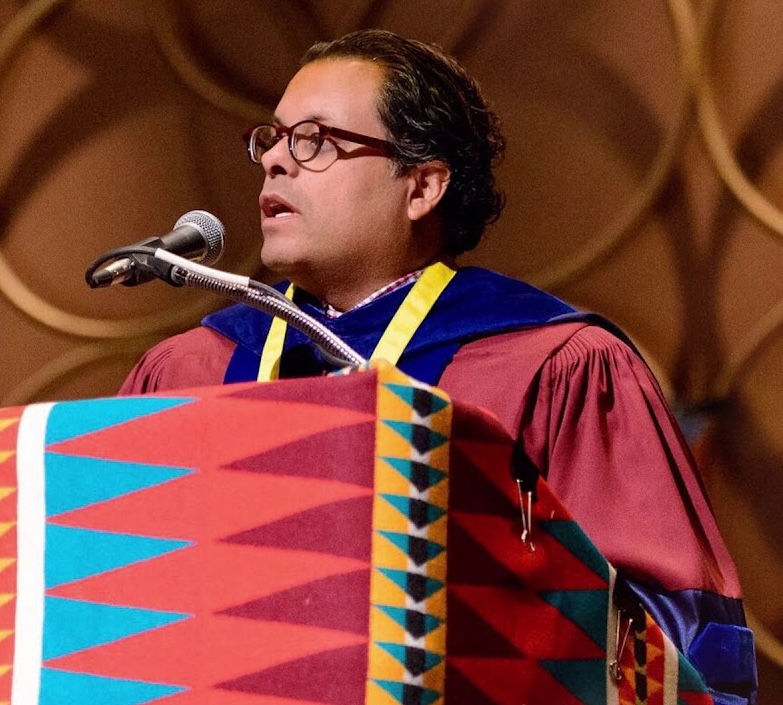
Bryan McKinley Brayboy
Much to my disgust, Brayboy spends most of this piece reflecting quite honestly on some of his thoughts about what it means to be a “real Indian.” He explores indigenous authenticity, and positions himself above some of his research participants as an “authentic Indian.” He simultaneously reflects on his own felt experience as an “outsider” amongst his own people – the paradox of his perspectives are quite outstanding. Brayboy discusses how he is well versed in being damaged by other’s perspectives of indigenous authenticity, yet finds himself in his reflections acting as if he is the one in charge of determining who can be called a “real Indian” – to which I found myself becoming increasingly angry.
This piece has encouraged me to reflect on my perspective of whakapapa “being enough,” and the juxtaposition this poses when the reality is that although I do have whakapapa, I also sit on the outside of my culture as diaspora, living here in Aotearoa. This is compounded by the fact I was raised disconnected from my culture, perpetuating my sense of “outsiderness.” The paradox of this internal battle is that there is truth on both sides – I am not well-versed in the ways of my people, I do not speak our reo, nor do I know well our tikanga. In this sense, I am not very “Cook Island,” however, on the other hand, I am Cook Island purely because it is in my whakapapa. It raises the question in me; is whakapapa enough?
For us, as indigenous people, we might be or want to be deemed as on the “inside” however, as Brayboy has alluded to, this is a layered conversation. With us comes our own internal biases regarding what a “real indigenous” person, looks, sounds, and behaves like, as well as our own internal pressures to feel as though we are living up to those standards. This also impacts the way we might engage with and treat Indigenous participants who agree to be a part of our research. How do we see them? Do we (subconsciously) dismiss what they say and contribute to colonial mindsets because of our biases about what gives someone cultural validity? Will we find ourselves having reflections like Brayboy, frustrated with the “wannabe” attitude of some of our participants, despite being “damaged by other’s perspectives” ourselves? I do not yet hold any of these answers to these questions, but I guess it is food for thought.
 Te Wahine Atamai
Leave a comment